Intermittent Fasting Timer & Metabolic Tracker
Calculate fasting schedules (16:8, 18:6, 20:4, OMAD) and track metabolic state transitions for ketosis, glycogen depletion, and autophagy.
| Fasting Timeline Phase | Metabolic Transition State | Hormonal & Cellular Action |
|---|
Intermittent Fasting Timer & Metabolic Tracker
Intermittent Fasting Timer & Metabolic Tracker is an interactive health and culinary utility engineered for intermittent fasters, keto dieters, and health enthusiasts. It computes target fasting finish times, eating window schedules, percentage progress bars, and metabolic state transitions-including glycogen depletion, ketosis fat oxidation, and cellular autophagy-inside client-side JavaScript memory.
Understanding Intermittent Fasting Timer
An individual pursuing weight loss and metabolic health begins a 16:8 intermittent fast at 8:00 PM after finishing dinner. By 10:00 AM the following morning (14 hours elapsed), they feel mild hunger pangs and assume their body is starving, contemplating breaking the fast early with a sugary pastry. Breaking the fast at hour 14 interrupts metabolic transition just as liver glycogen stores reach full depletion and circulating insulin drops to baseline levels. The body was on the verge of entering peak nutritional ketosis, where liver enzymes convert fatty acids into acetoacetate ketone bodies for brain energy.
Entering an 8:00 PM start time and 14 elapsed hours in this fasting tracker displays the exact metabolic state: Ketosis Fat Oxidation Mode (87.5% Complete), with 2 hours remaining until target finish at 12:00 PM. Visualizing metabolic transition milestones encourages completing the full 16-hour fast.
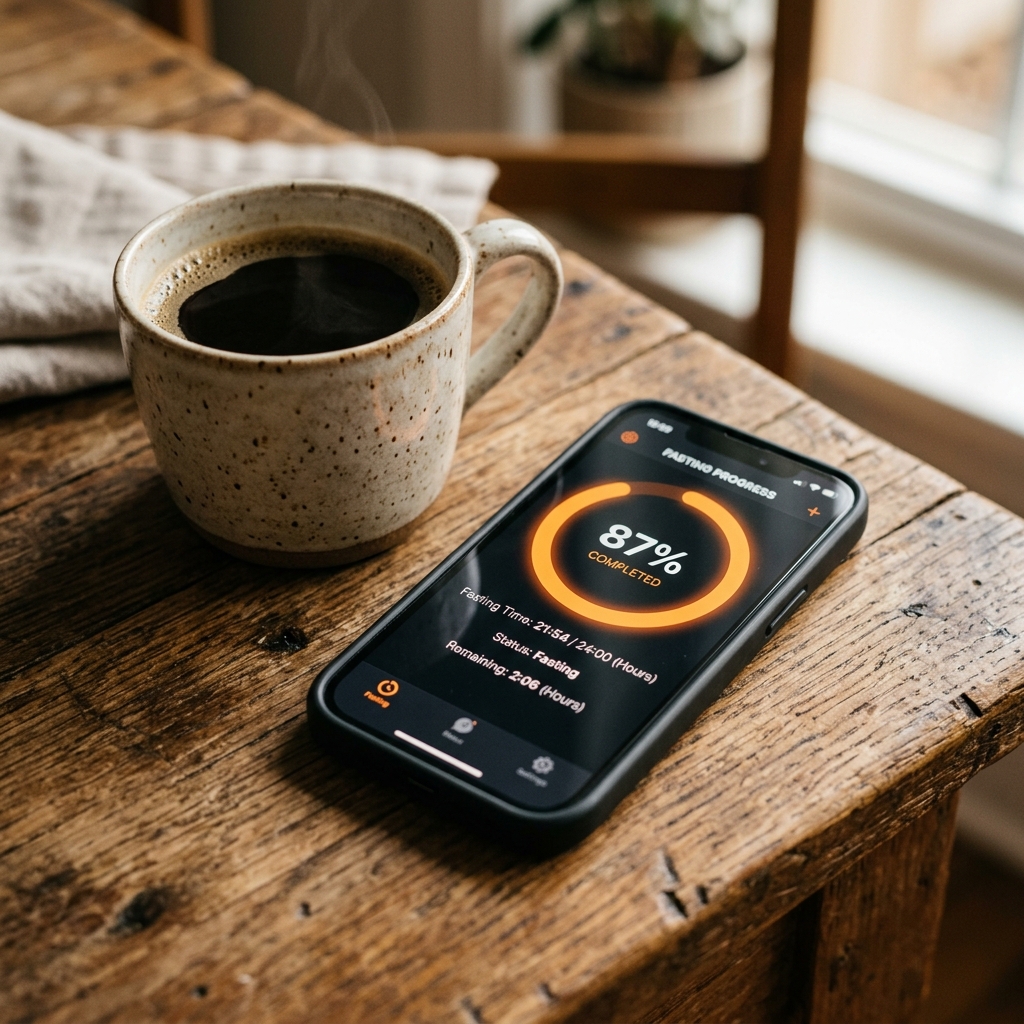
Intermittent fasting is an evolutionary metabolic adaptation governed by hormonal regulation. Consuming food stimulates pancreatic insulin secretion, promoting glucose storage in liver and muscle glycogen reserves ($\approx 400\text{g}$ total capacity). Fasting initiates a metabolic shift from glucose oxidation to fat oxidation. As blood glucose and insulin levels decline over 12 to 16 hours, glucagon secretion increases, mobilizing triglycerides from adipose tissue into free fatty acids ($\text{FFA}$).
How Intermittent Fasting Timer Works
When you select a fasting protocol, specify fast start time, enter elapsed fasting hours, and select daily physical activity, the calculator executes a metabolic timeline algorithm. Step one determines target fast duration in hours: 16:8 Leangains (16h), 18:6 Intermediate (18h), 20:4 Warrior (20h), 24h OMAD (24h), or 36h Extended (36h).
Step two computes target completion time: finish_time = start_time + target_hours. Step three evaluates current metabolic phase based on elapsed hours: 0-4h (Anabolic Digestion & Blood Glucose Rise), 4-12h (Post-Absorptive Glycogen Depletion), 12-18h (Nutritional Ketosis & Fat Oxidation), 18-24h+ (Cellular Autophagy & HGH Surge). Step four calculates percentage completion ($P_{fast} = \frac{t_{elapsed}}{t_{target}} \times 100$) and provides gentle re-feeding meal suggestions.
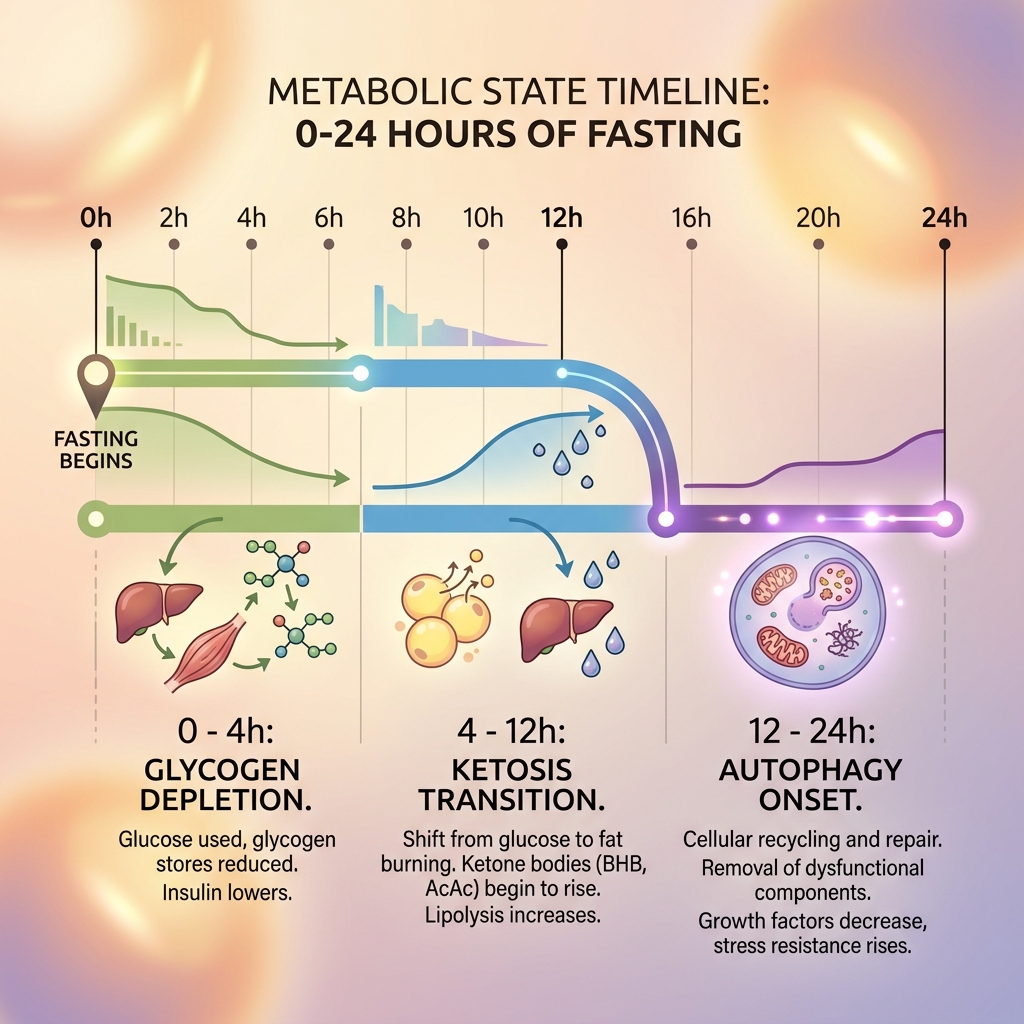
The Math Behind It
The core fasting timeline solver operates in client-side JavaScript:
// Metabolic fasting state transition solver
function computeFastingSpecs(protocolKey, startStr, elapsedHours) {
    const targetHourMap = { '16_8': 16.0, '18_6': 18.0, '20_4': 20.0, '24_omad': 24.0, '36_extended': 36.0 };
    const targetHours = targetHourMap[protocolKey] || 16.0;

    const pctComplete = Math.min(100.0, (elapsedHours / targetHours) * 100.0);
    const hoursLeft = Math.max(0, targetHours - elapsedHours);

    let stateMsg = 'Anabolic Digestion Phase';
    if (elapsedHours >= 18.0) stateMsg = 'Cellular Autophagy & HGH Surge';
    else if (elapsedHours >= 12.0) stateMsg = 'Nutritional Ketosis Fat Oxidation';
    else if (elapsedHours >= 4.0) stateMsg = 'Post-Absorptive Glycogen Depletion';

    return {
        targetHours: targetHours,
        pctComplete: pctComplete.toFixed(1),
        hoursLeft: hoursLeft.toFixed(1),
        stateMsg: stateMsg
    };
}
Autophagy & Human Growth Hormone (HGH) Science
Autophagy ($\text{auto}$ = self, $\text{phagy}$ = eat) is a cellular lysosomal degradation pathway discovered by Dr. Yoshinori Ohsumi (2016 Nobel Prize). Fasting suppresses mammalian target of rapamycin ($\text{mTOR}$) signaling, triggering cells to recycle dysfunctional mitochondria ($\text{mitophagy}$) and misfolded proteins. Extended fasting over 24 hours increases Human Growth Hormone ($\text{HGH}$) secretion up to 5-fold, preserving lean muscle tissue mass.
Practical Uses for Intermittent Fasting Timer
16:8 Daily Intermittent Fasting: Track daily 16-hour overnight fasts and manage 8-hour feeding windows (e.g., 12:00 PM to 8:00 PM).
OMAD (One Meal A Day) 24h Fasting: Calculate 24-hour fast completion times for single daily dinner feasts.
Ketosis State Transition Monitoring: Track the exact hour (hour 12 to 14) when fat oxidation accelerates during fasting.
Autophagy Milestone Tracking: Monitor extended 24 to 36-hour fasts to maximize cellular repair and anti-aging benefits.
Gentle Re-Feeding Meal Planning: Schedule appropriate light re-feeding meals (bone broth, eggs, avocado) when breaking extended fasts.
Circadian Rhythm Eating Alignment: Align eating windows with daylight hours to optimize metabolic insulin sensitivity.
Getting the Most Out of Intermittent Fasting Timer
Stay hydrated with zero-calorie fluids during fasting windows. Drink plenty of plain water, sparkling water, black coffee, or unflavored green tea during fasts. Fluid intake suppresses ghrelin hunger hormones and prevents dehydration headaches.
Add a pinch of sea salt or electrolytes to water during extended fasts. Fasting causes kidneys to excrete sodium rapidly ($\text{natriuresis of fasting}$). Adding electrolyte minerals (sodium, potassium, magnesium) prevents fatigue and muscle cramps.
Do not consume calories that trigger insulin during fasts. Avoid adding milk, cream, sugar, or collagen powder to coffee during fasting windows. Even small calorie additions trigger insulin release, pausing fat oxidation.
Break your fast gently with bone broth or healthy fats. Avoid breaking a fast with high-sugar carbohydrates or large heavy meals. Start with bone broth, poached eggs, or half an avocado to ease digestive enzyme production.

Prioritize nutrient-dense whole foods during feeding windows. Intermittent fasting is not a license to overeat ultra-processed junk food during feeding windows. Focus on lean proteins, fiber-rich vegetables, and healthy fats.
Listen to your body and stop fasts if feeling unwell. Mild hunger pangs pass within 20 minutes. However, if you experience dizziness, severe nausea, or cold sweats, break your fast immediately with a light balanced meal.
Intermittent Fasting Timer Technical Specifications
Algorithm & Metabolic Milestone Math
Metabolic timeline solver: Fast completion calculated via temporal addition ($t_{finish} = t_{start} + t_{protocol}$). Metabolic states evaluated against physiological thresholds ($4\text{h}, 12\text{h}, 18\text{h}, 24\text{h}$). Output formatted in target finish time, remaining hours, % progress, and re-feeding guidance.
Execution Speed & Efficiency
Calculations execute within 0.1 milliseconds in client-side JavaScript memory without external network requests.
Data Privacy & Local Storage
100 percent local browser execution. No fasting schedules, start times, or personal health inputs are stored or transmitted online.
Browser Support
Fully compliant with modern ECMAScript 5+ standards across Chrome, Safari, Firefox, Edge, and mobile web browsers.
| Feature | This Tool | Generic Phone App | Wall Clock Estimate |
|---|---|---|---|
| Calculation Speed | < 1 ms | Requires login/cloud | Visual estimate |
| Metabolic State Tracking | Anabolic, Glycogen, Ketosis, Autophagy | Premium paywall feature | None |
| Re-Feeding Meal Guidance | Re-feeding food suggestions | None | None |
| Data Privacy | 100% Local (No server/cookies) | User tracking & ads | Manual notes |
Frequently Asked Questions
What is the 16:8 intermittent fasting protocol?
The 16:8 intermittent fasting protocol involves fasting for 16 consecutive hours overnight and confining daily food consumption to an 8-hour eating window (e.g., 12:00 PM to 8:00 PM).
What metabolic changes occur during a 16-hour fast?
During a 16-hour fast, insulin levels drop, liver glycogen stores deplete, and the body transitions into mild nutritional ketosis, increasing beta-oxidation of stored body fat for energy.
When does cellular autophagy begin during fasting?
Cellular autophagy-the process where cells recycle damaged proteins and organelles-typically initiates between 18 and 24 hours of continuous fasting as nutrient-sensing mTOR pathways turn off.
What liquids are allowed during the fasting window?
Zero-calorie liquids that do not trigger insulin are allowed: plain water, black coffee, plain unflavored green or black tea, herbal tea, and sparkling water.
What is the best way to break an extended fast?
Break a fast gently with easily digestible foods: bone broth, poached eggs, avocado, or a small handful of nuts. Avoid high-sugar or heavy carbohydrates immediately upon breaking a fast to prevent digestive upset.
Related Kitchen Tools
Nutrient & Calorie Calculator - Calculate recipe calories, protein, carbs, and fat splits.
Serving Size Calculator - Volumetric recipe portion and yield calculator.
Food Shelf Life Guide - Storage expiration timelines across pantry, fridge, and freezer.