Baking Ratio Calculator - Free Pastry & Dough Math Tool
Scale fundamental pastry and dough formulas by weight using classic culinary ratios for pie crusts, pound cakes, choux, and cookies.
| Ingredient | Ratio Parts | → | Required Weight (Grams) |
|---|
Baking Ratio Calculator - Free Pastry & Dough Math Tool
Baking Ratio Calculator is a browser utility designed for pastry chefs, bakers, and culinary students to scale core dough and batter formulas by weight using fundamental culinary ratios. It computes ingredient allocations locally inside JavaScript memory without requiring server data logging.
Understanding Baking Ratio Calculator
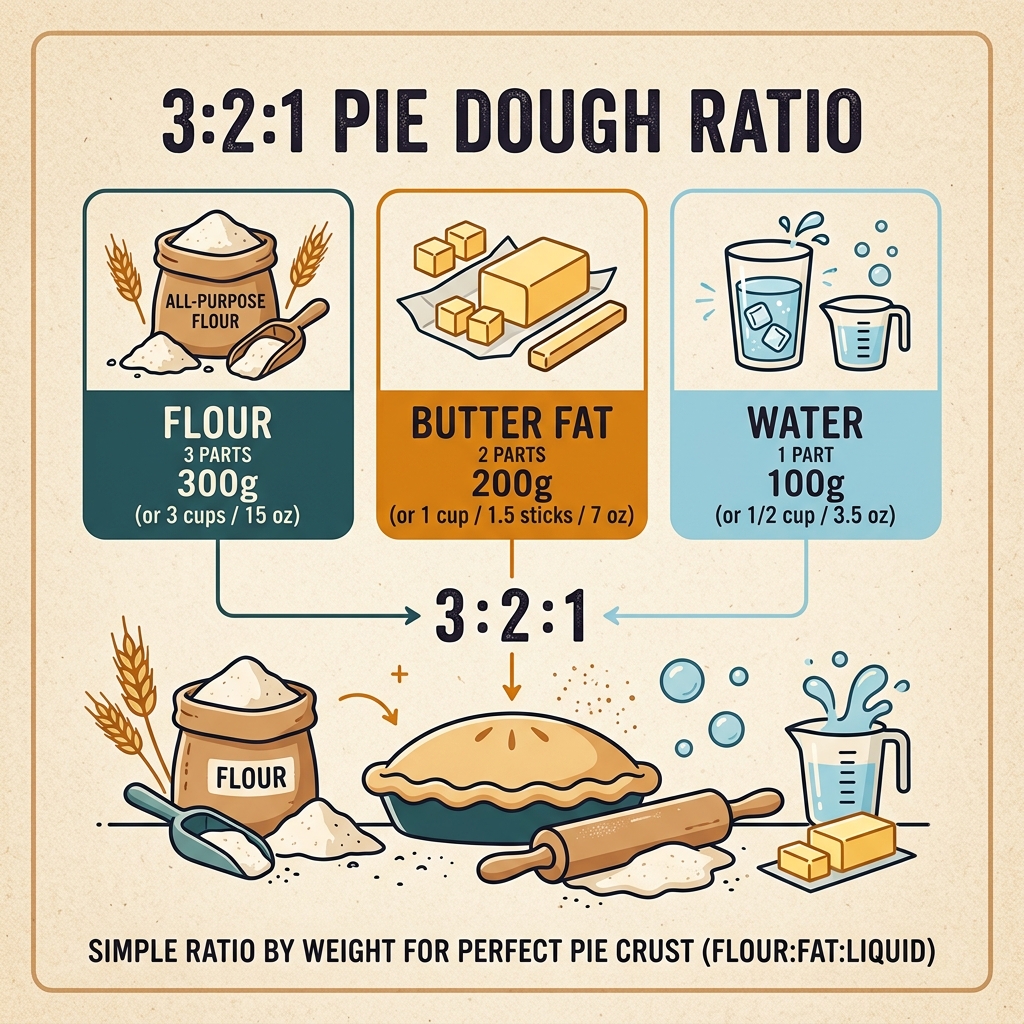
A pastry chef in New York prepares a batch of French shortcrust pie dough for a dessert menu. Standard recipe books list volumetric cups and tablespoons, but volumetric flour measurements fluctuate up to 30 percent based on packing tightness. Utilizing fundamental baking ratios codified by culinary author Michael Ruhlman, traditional pie dough follows a strict 3:2:1 weight ratio consisting of 3 parts flour, 2 parts fat (cold butter or lard), and 1 part ice water. Entering a base flour weight of 300 grams into this calculator formulates exact structural quantities: 300 grams flour, 200 grams cold butter, and 100 grams ice water. The result is a tender, flaky pie crust with perfect gluten-fat balance.
Baking is fundamentally structural chemistry. Unlike savory cooking where seasoning can be adjusted to taste at the end of preparation, baking relies on precise weight proportions between starches, fats, liquids, and leaveners to establish crumb architecture. Utilizing weight ratios allows pastry chefs to bake without recipe books, adapting batch sizes smoothly to fit any cake pan dimension or production quota.
This calculator processes ratio scaling equations by establishing a unit weight factor: unit_factor = base_flour_weight / flour_ratio_parts. Multiplying this unit factor by each remaining ingredient ratio part determines exact gram weights. Fat coats flour proteins, limiting gluten development, while liquid hydrates starches and dissolves sugar crystals. Maintaining exact weight ratios preserves target crumb tenderness and structural stability.
Commercial bakeries rely on ratio scaling to maintain batch consistency across multiple shift bakers. Memorizing core ratios like 1:1:1:1 for pound cake or 2:1:1:2 for choux pastry enables bakers to scale production instantly without looking up static recipe cards, protecting product quality and preventing ingredient waste.
How Baking Ratio Calculator Works
When you input base flour weight and ratio parts for flour, fat, liquid, sugar, and eggs, the calculator executes a two-phase mathematical model. Phase one calculates single ratio part weight: unit_part_weight = base_flour_weight / ratio_flour_parts.
Phase two computes individual ingredient weights by multiplying unit part weight by each respective ratio value: fat_weight = unit_part_weight × ratio_fat_parts, liquid_weight = unit_part_weight × ratio_liquid_parts, sugar_weight = unit_part_weight × ratio_sugar_parts, and egg_weight = unit_part_weight × ratio_egg_parts. Total batch mass equals the sum of all calculated ingredient weights.
The Math Behind It
The baking ratio engine executes cleanly in JavaScript:
// Fundamental baking ratio calculation engine
function computeBakingRatio(flourWt, rFlour, rFat, rLiquid, rSugar, rEgg) {
    const unitWeight = flourWt / rFlour;

    const fatWt = unitWeight * rFat;
    const liquidWt = unitWeight * rLiquid;
    const sugarWt = unitWeight * rSugar;
    const eggWt = unitWeight * rEgg;

    const totalBatchMass = flourWt + fatWt + liquidWt + sugarWt + eggWt;

    return {
        fat: fatWt.toFixed(1),
        liquid: liquidWt.toFixed(1),
        sugar: sugarWt.toFixed(1),
        egg: eggWt.toFixed(1),
        totalMass: totalBatchMass.toFixed(1)
    };
}
For a 3:2:1 pie dough formula with 300g flour, unit part weight equals 100g (300g / 3). Fat weight equals 200g (100g × 2) and liquid weight equals 100g (100g × 1), yielding a total batch mass of 600g.
Emulsification and Emulsion Stability
Fat-to-liquid ratios determine batter emulsification stability. High-fat batters like pound cake require gradual egg addition to prevent batter curdling during creaming.
Practical Uses for Baking Ratio Calculator
Artisan Pie Crust Production: A baker in Portland formulates flaky shortcrust for 20 double-crust pies. Setting base flour weight to 2400g with a 3:2:1 ratio generates 1600g butter and 800g ice water.
Traditional Pound Cake Formulation: A wholesale bakery in Atlanta scales classic 1:1:1:1 pound cake batter for eight 9-inch loaf pans, calculating 1800g flour, 1800g butter, 1800g sugar, and 1800g whole eggs.
Choux Pastry Cream Puffs: A pastry chef in San Francisco formulates eclairs using a 2:1:1:2 ratio (200g water, 100g butter, 100g flour, 200g eggs), generating hollow steam-puffed shells.
Shortbread Cookie Production: A baker in Boston calculates 3:2:1 shortbread cookies (3 parts flour, 2 parts butter, 1 part sugar), producing melt-in-mouth crumb textures.
American Biscuit and Scone Formulations: A bakery owner in Nashville formulates Southern buttermilk biscuits using a 3:1:2 ratio (3 parts flour, 1 part butter, 2 parts buttermilk), resulting in tall, flaky biscuit layers.
Sponge Cake Batter Scaling: A wedding cake designer in Los Angeles scales Genoise sponge batters using a 1:1:1 ratio (equal weights flour, sugar, and eggs) to fill deep 12-inch cake rounds without overflow.
Getting the Most Out of Baking Ratio Calculator
Weigh liquid ingredients in grams. Water, milk, and eggs should be weighed on a digital scale in grams rather than measured in volumetric fluid ounces for maximum precision.
Add salt and leaveners as small percentages. Ratios define major structural ingredients. Add kosher salt at 1.5 to 2.0 percent of flour weight and baking powder at 1.0 to 1.5 percent.
Combine with the Cup to Gram Converter. Convert legacy cup-based family recipes into weight values using our Cup to Gram Converter before applying ratio scaling.
Maintain temperature parameters for fats. Cold solid butter preserves discrete fat layers in 3:2:1 pie dough, whereas room temperature butter emulsifies into pound cake batters.
Baking Ratio Calculator Technical Specifications
Algorithm
Unit factor ratio solver: unit = flour_weight / ratio_flour. Component allocation: ingredient_weight = unit × ratio_part. Output values rounded using JavaScript Number.prototype.toFixed(1).
Performance
Ratio calculations execute within 0.1 milliseconds on desktop browsers and under 0.3 milliseconds on mobile web views.
Data Privacy
Zero server transmission. All ratio parameters and weight calculations execute locally in client-side JavaScript memory.
Browser Support
Compatible with browsers supporting ECMAScript 5+, including Chrome, Safari, Firefox, Edge, and Opera.
| Feature | This Tool | Generic Calculators | Spreadsheets |
|---|---|---|---|
| Calculation Speed | < 1 ms | 300 - 800 ms | Varies |
| Culinary Ratio Presets | Pie crust, Pound cake, Choux, Cookies | None | Manual setup |
| Multi-Part Ratio Engine | Included (5-part scaling) | Simple 2-part only | Manual formula |
| Data Privacy | 100% Local (no server) | Server-side logging | Cloud account sync |
Frequently Asked Questions
What is the classic 3:2:1 baking ratio for pie crust?
The classic 3:2:1 shortcrust ratio consists of 3 parts flour, 2 parts fat (butter or lard), and 1 part ice water by weight. For example, 300g flour, 200g butter, and 100g water forms a traditional pie crust.
Why are baking ratios calculated by weight instead of volume?
Flour and sugar densities vary by up to 30 percent depending on packing tightness and humidity. Weight-based ratios guarantee identical chemical structure across batch sizes.
What is the core structural ratio of a traditional pound cake?
A traditional pound cake follows a 1:1:1:1 ratio consisting of equal parts flour, butter, sugar, and whole eggs by weight.
How does the choux pastry ratio differ from standard cake batters?
Choux pastry utilizes a 2:1:1:2 ratio (2 parts liquid, 1 part butter, 1 part flour, 2 parts eggs). High liquid content creates steam during baking, expanding dough into hollow shells.
Can custom baking ratios be scaled using a base flour mass?
Yes. Divide your base flour weight by the flour ratio part value to determine the unit multiplier, then multiply that value by each remaining ratio part.
Related Kitchen Tools
Pizza Dough Calculator - Formulate pizza dough recipes using baker's percentages.
Sourdough Hydration Calculator - Calculate true overall sourdough hydration factoring starter moisture.
Cup to Gram Converter - Convert volume flour, butter, and sugar measurements into precise gram weights.